


One of the first lessons I learned in business had nothing to do with finance, operations or strategy. It was about keeping one’s word. Old school, I know. And sometimes my old-school approach causes me some headaches in this new world. But over time, I have refused to unsee the value it inherently holds.
The men and women who taught me about life and business placed enormous emphasis on being known as trustworthy. If they committed to a delivery date, they delivered. If they agreed to a payment schedule, they honoured it. If circumstances changed and they could no longer fulfil a commitment, they communicated early and accepted responsibility. To them, a person’s name is not separate from their business. It is one of its most valuable assets.
At the time, I interpreted these lessons primarily as matters of character. Many years later, especially after studying Economics at postgraduate level, I have begun to wonder whether they were actually teaching me economics.
The more experience I gain, the more I notice that businesses often succeed or fail because of factors that do not appear neatly on financial statements. Customers return because they trust a supplier. Employees stay because they believe management will treat them fairly. Lenders exercise patience because a borrower has developed a reputation for honesty. Communities support a company because it has demonstrated reliability over many years.
The old school had a simple phrase for all of this: keeping one’s word.
Modern business tends to use a different language. We talk about reputation, stakeholder confidence, social licence, brand equity and goodwill. Yet before we celebrate goodwill as some hidden force that accountants and investors fail to understand, it is worth asking a more difficult question.
Is goodwill really invisible? Or have markets been recognising its value all along?
Take Coca-Cola.
The company’s factories, trucks, warehouses and bottling plants are valuable, but few would argue that they explain the entirety of its worth. The same can be said for Apple, Visa, Mastercard, Toyota or Berkshire Hathaway. A substantial portion of their value derives from the fact that millions of customers, suppliers, employees and investors have developed confidence in them over time.
In other words, markets clearly place a value on goodwill.
Investors may not always use that term, but they recognise its consequences. They reward businesses that attract loyal customers. They reward firms that can charge premium prices. They reward organisations that retain talent, navigate crises and maintain durable relationships.
The question therefore is not whether goodwill has value. The question is whether we fully understand where that value comes from. This distinction matters because goodwill is often discussed as though it were a marketing achievement. It is not.
A brand can be advertised. Goodwill must be earned.
A company can spend millions creating awareness. It cannot spend millions creating credibility. Credibility is accumulated through behaviour. It emerges from promises honoured, obligations fulfilled and relationships preserved over time.
This is where the lessons of the old school become relevant again.
The businesspeople who shaped my early thinking were not nostalgic romantics. Many had survived difficult economic periods, political uncertainty, banking challenges and unforgiving markets. Their insistence on keeping one’s word was more than moral theatre. It was commercial pragmatism. They understood something that many entrepreneurs discover only after experience teaches it to them.
Every transaction leaves a residue. Sometimes it leaves confidence. Sometimes it leaves doubt. Over time, those residues accumulate.
A supplier remembers whether you paid on time when cash was tight. A customer remembers whether you stood behind your product when something went wrong. An employee remembers how he was treated when circumstances became difficult. Years later, these memories often influence decisions more than formal agreements ever will.
This is why I increasingly think of goodwill not as reputation but as a form of accumulated confidence. And accumulated confidence behaves in surprising ways.
Unlike machinery, it does not depreciate predictably.
Unlike cash, it cannot be transferred easily.
Unlike inventory, it cannot be counted.
Yet it often compounds.
One fair action creates an opportunity. That opportunity creates a relationship. That relationship creates an introduction. That introduction opens a door that would otherwise have remained closed. By the time outsiders observe the outcome, they frequently attribute it to luck, influence or networking.
What they are often observing is the delayed return on years of accumulated goodwill. This may explain why some entrepreneurs consistently seem to attract opportunities that others miss. The explanation is not always superior intelligence or greater resources. Sometimes it is simply that more people are willing to take their calls, extend them patience, introduce them to partners or give them another chance when circumstances become difficult.
Goodwill creates options. And options have economic value. Businesses with substantial reserves of goodwill often discover that they have more room to manoeuvre when circumstances change. Goodwill, in effect, expands a firm’s strategic degrees of freedom. It creates possibilities that do not exist for organisations whose relationships are purely transactional.
Yet there is another side to this argument.
If goodwill is so valuable, why do we struggle to measure it?
Part of the answer lies in timing. Markets often recognise goodwill only after it has produced observable outcomes.
An investor can see customer retention. He cannot easily see the thousands of interactions that created that loyalty. A lender can observe repayment performance. She cannot easily quantify the reputation that made borrowers determined to protect their standing. An acquirer can justify paying a premium for a business. What remains much harder is calculating the precise value of the trust, fairness and reliability that generated the premium in the first place.
In this sense, goodwill resembles health. Its value becomes most obvious when it deteriorates.
A company may appear successful long after its goodwill has begun to erode. Revenue remains strong. Contracts remain in place. Operations continue.
Yet subtle changes begin to appear.
Customers become less forgiving. Suppliers demand stricter terms. Employees become less committed. Partners become more cautious. Nothing dramatic happens immediately. But the reservoir of goodwill is slowly draining.
When difficulties eventually arise, the difference becomes impossible to ignore. One company receives patience. Another receives pressure. One receives support. Another receives scrutiny. One survives. Another struggles.
Observers often describe these outcomes as resilience. In many cases, resilience is simply goodwill being tested.
This is why the old emphasis on keeping one’s word remains remarkably relevant, even in an era of artificial intelligence, digital platforms and sophisticated financial systems.
The point is not that contracts are unnecessary or that modern governance should be replaced by handshakes. The old world had its flaws. Informal networks can become exclusionary. Personal relationships can become substitutes for accountability.
The lesson is something subtler.
Systems function best when they are reinforced by character. Contracts work best when counterparties intend to honour them. Rules work best when people believe in them. And businesses perform best when stakeholders have confidence that promises will be kept, even when keeping them becomes inconvenient.
Perhaps that is why the businesspeople who trained me spoke so often about protecting one’s name. They understood that a name is more than merely an identity. It is a store of economic value.
Long before accountants record goodwill on a balance sheet, and long before investors reward it through a valuation premium, people are making decisions based on whether they believe your word means something.
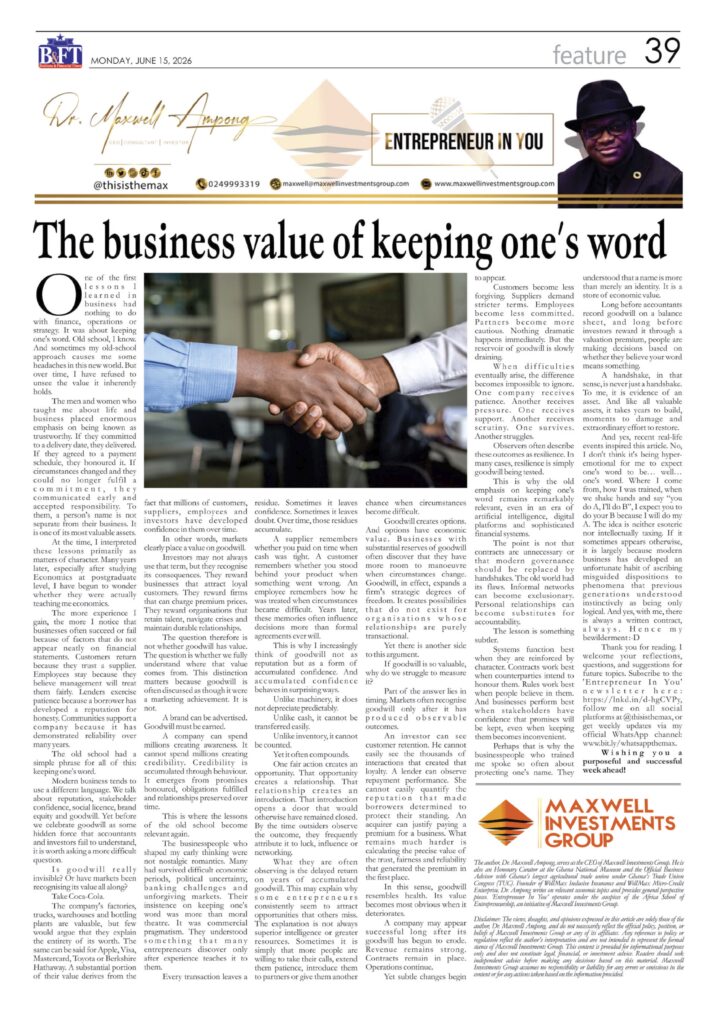
A handshake, in that sense, is never just a handshake. To me, it is evidence of an asset. And like all valuable assets, it takes years to build, moments to damage and extraordinary effort to restore.
And yes, recent real-life events inspired this article. No, I don’t think it’s being hyper-emotional for me to expect one’s word to be… well… one’s word. Where I come from, how I was trained, when we shake hands and say “you do A, I’ll do B”, I expect you to do your B because I will do my A. The idea is neither esoteric nor intellectually taxing. If it sometimes appears otherwise, it is largely because modern business has developed an unfortunate habit of ascribing misguided dispositions to phenomena that previous generations understood instinctively as being only logical. And yes, with me, there is always a written contract, always. Hence my bewilderment 😀
Thank you for reading. I welcome your reflections, questions, and suggestions for future topics. Subscribe to the ‘Entrepreneur In You’ newsletter here: https://lnkd.in/d-hgCVPy, follow me on all social platforms at @thisisthemax, or get weekly updates via my official WhatsApp channel: www.bit.ly/whatsappthemax.
Wishing you a purposeful and successful week ahead!
♕ —- ♕ —- ♕ —- ♕ —- ♕
Disclaimer: The views, thoughts, and opinions expressed in this article are solely those of the author, Dr. Maxwell Ampong, and do not necessarily reflect the official policy, position, or beliefs of Maxwell Investments Group or any of its affiliates. Any references to policy or regulation reflect the author’s interpretation and are not intended to represent the formal stance of Maxwell Investments Group. This content is provided for informational purposes only and does not constitute legal, financial, or investment advice. Readers should seek independent advice before making any decisions based on this material. Maxwell Investments Group assumes no responsibility or liability for any errors or omissions in the content or for any actions taken based on the information provided.